
Verification and accepted packs
ATEX Filling Accuracy & Checkweighing
Agree what quantity is measured, how a result is checked and when a pack is accepted. Keep the test method compatible with flammable-liquid handling.
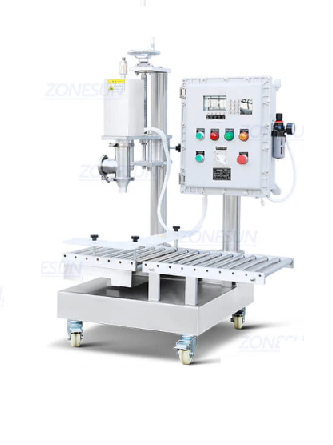
Direct answer
Verify the product in the pack, not only the number on the filler.
Filling accuracy is established by comparing the actual quantity in completed packs with the declared target using a suitable verification method. A load-cell reading, flowmeter pulse total or programmed volume is a process measurement, not automatically independent evidence of the quantity sold. Define tare, temperature, closure state, measurement timing and the treatment of rejected packs before comparing results.
For flammable liquids, the checking station, open-pack time, handling and any returned product also belong in the hazardous-area review. This guide explains how to specify a check, not how to certify a machine or approve a quantity-control system. Agree the applicable legal-metrology requirements with a competent adviser or Trading Standards.
Measurement terms
Separate a dose setting, repeatability, accuracy and legal quantity.
| Term | Meaning in a filling project | What it does not prove |
|---|---|---|
| Target or nominal quantity | The quantity the recipe aims to deliver or the quantity declared on the pack. | That every finished pack contains the target. |
| Net quantity | Product quantity after accounting for the correct container and closure tare. | That a fixed assumed tare is adequate for varying packs. |
| Repeatability | How closely results group under the same stated conditions. | That a closely grouped result is centred on the correct target. |
| Measurement resolution | The display interval or smallest reported increment. | The uncertainty or accuracy of the complete measuring system. |
| Verification tolerance | The agreed acceptance limit with a stated method and conditions. | A universal percentage applying to every liquid, fill size or legal packing system. |
Test design
Write a verification method that can be repeated at FAT and on site.
- Define whether the declared quantity is mass or volume and which pack formats and product variants the result must cover.
- Identify a suitable reference instrument and how its checks, calibration status and measuring uncertainty will be assessed.
- State what is included in the tare: container, cap, liner, label and any other parts present during weighing.
- Define the timing and state of the check, including how the container is closed, how spills are excluded and how evaporation is limited under the assessed handling procedure.
- Agree the sample plan, the representation of each filling head and the inclusion of start-up, normal running, pause/restart and batch-end conditions.
- Record individual results and outliers before adjustment. State who may adjust the process and what recheck is required before release.
The mass relationship is net product mass = filled-pack mass − the applicable empty-pack mass. Converting mass to volume additionally requires suitable product-density data at the defined conditions. Do not assume that water density, a label value or one temperature represents a solvent blend, fragrance or filled coating throughout production.
Diagnostic evidence
Use the pattern of errors to narrow the investigation.
| Observed pattern | Evidence to gather | Potential area for investigation |
|---|---|---|
| All heads shift after a product change | Product identity, density basis, recipe revision and agreed reference checks. | An incorrect recipe or quantity conversion rather than a single faulty nozzle. |
| One head differs from the others | Head-specific samples, visible drip observations and service history. | An individual product-path, cut-off or adjustment issue. |
| Readings change with container movement | Timing of weighing, container contact and observed hose position. | Mechanical forces or an unstable acceptance point. |
| Checks differ between open and closed packs | Closure state, elapsed time, external product and tare basis. | Evaporation, inconsistent measurement state or an incorrect tare convention. |
| Mean rises when flow is reduced | Recorded fill profile, transfer conditions and stop behaviour. | Product in flight or cut-off compensation requiring a reviewed setup check. |
Stop and make the equipment safe under the authorised procedure before physical investigation. Do not defeat an earthing, extraction, guarding or overfill interlock to improve a result or complete a test. These patterns guide evidence collection; they are not fault diagnoses or instructions to change safety settings.
Inspection and reject handling
Put the checkweigher into the line’s real operating environment.
Define whether checking is an off-line sample task, an in-line check after closing or a function of the filling station itself. Where independence is needed, using the filler’s own reading twice is not an independent check. State the reference, information transfer and failure response explicitly.
A separate checkweigher must suit its installation location and operating conditions. A closed cap does not by itself establish that the surrounding area is unclassified. Conveyor contact, speed changes, accumulation and pack stability can affect a dynamic check, while a manual sample station needs an approved safe handling method. Include the reject route: identify, segregate and reconcile suspect packs instead of letting them re-enter accepted stock unnoticed.
Use complete-line planning to define the boundary between filler, capper, verification and rejection. Compare flowmeter and load-cell filling when selecting the process measurement, and FAT and SAT evidence when agreeing how the system will be accepted.
UK quantity-control context
Machine tolerance and the packer’s legal duties are different questions.
GOV.UK describes minimum and average systems for packaged goods within the applicable scope. Its packaged-goods guidance covers quantities from 5 g to 25 kg and 5 ml to 25 litres and distinguishes the average-system conditions from a simple machine tolerance. Do not apply those package limits or the associated rules to every larger drum or IBC by analogy; establish the applicable requirements for the sale.
A statement such as “±1%” in machinery reference data is not approval of a legal quantity-control system. Suitable equipment, the chosen packing system, the checking method and required records must be established for the actual operation. No claim of trade approval for a Lancing machine is made here.
Primary guidance: GOV.UK packaged goods and packing systems and measuring equipment and records. Hazardous-area equipment placement remains subject to the site’s DSEAR assessment.
Buyer questions
Questions about solvent-filling accuracy and verification.
What filling accuracy can be guaranteed for my solvent?
The guarantee must be defined in an agreed application specification, not taken from a general platform description. It needs the target quantity, product and temperature, container, measurement basis, test method, sample plan and operating conditions. Lancing can use that brief to establish what must be demonstrated; this guide adds no accuracy promise.
How can I reduce product giveaway without increasing underfills?
First establish the causes and spread of fill variation with a trustworthy measurement method. Reducing an unnecessarily high target before controlling the variation can create underfilled packs. Review tare, cut-off, product condition, recipe control and the applicable quantity rules together, then validate an authorised adjustment against the agreed acceptance plan.
Does an uneven visible fill level prove that bottle weights are wrong?
No. Container internal-volume variation, foam and different product conditions can change the visible level. Weighing or volume verification under a defined method is needed to decide whether the quantity is wrong. A consistent-looking fill level also does not prove correct net quantity.
Why can a solvent sample weigh differently after it has stood open?
Loss of volatile material is one possible reason, but the result also depends on timing, temperature, container tare and external drips. Record those conditions and use a safe, repeatable closing and checking method. Do not compensate the filler for an uncontrolled verification procedure or leave flammable samples open outside the assessed process.
Evidence for a useful enquiry
Send fill results with the conditions that produced them.
Provide the product SDS, target quantity, pack and closure details, present measuring method, head-by-head results where available and the symptoms you need to resolve. Agree sample handling before sending any material.