
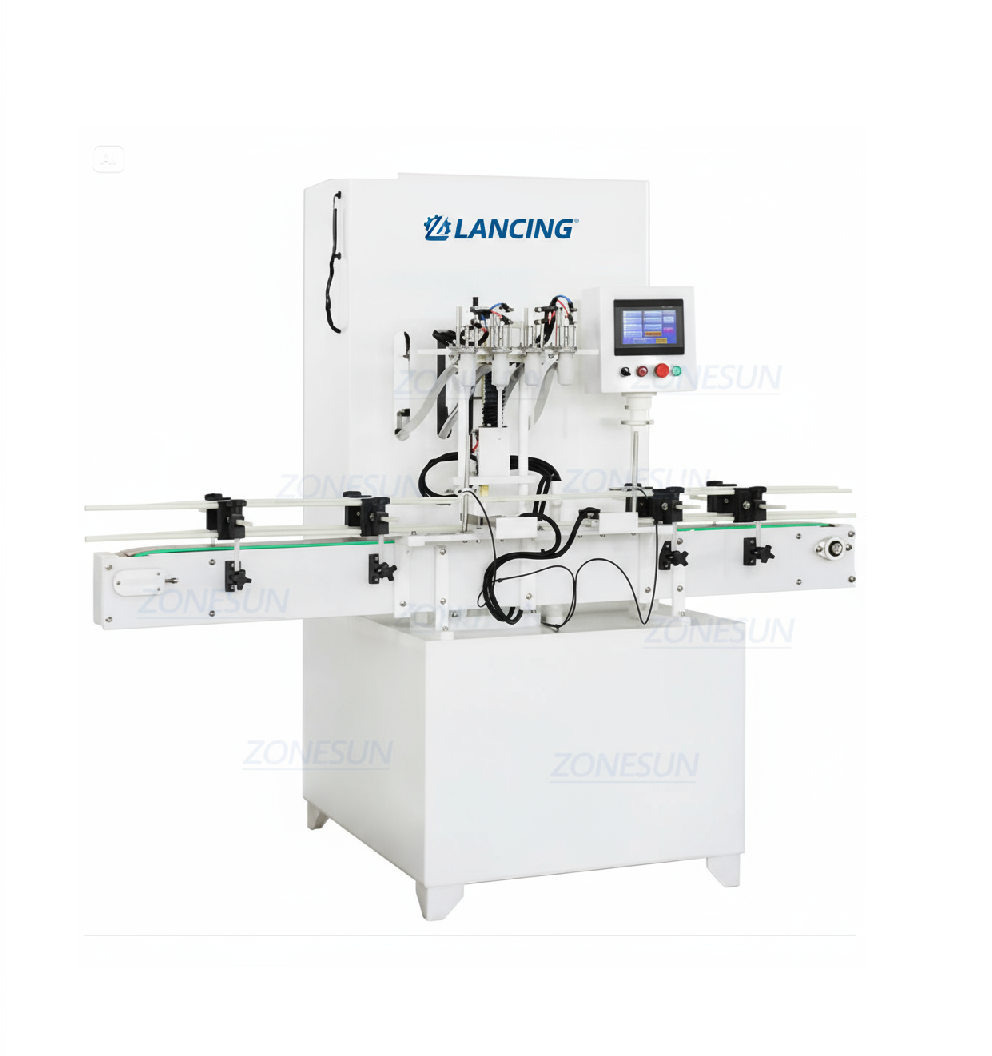
Automatic anti-corrosion filler
Reference LUYTCR4A gravity platform for conveyor-fed bottles.
- 100–3000 ml reference range
- 4 heads standard platform
- Approximately 200–2500 bottles/hour
- PP frame with PTFE/PVC contact-route options
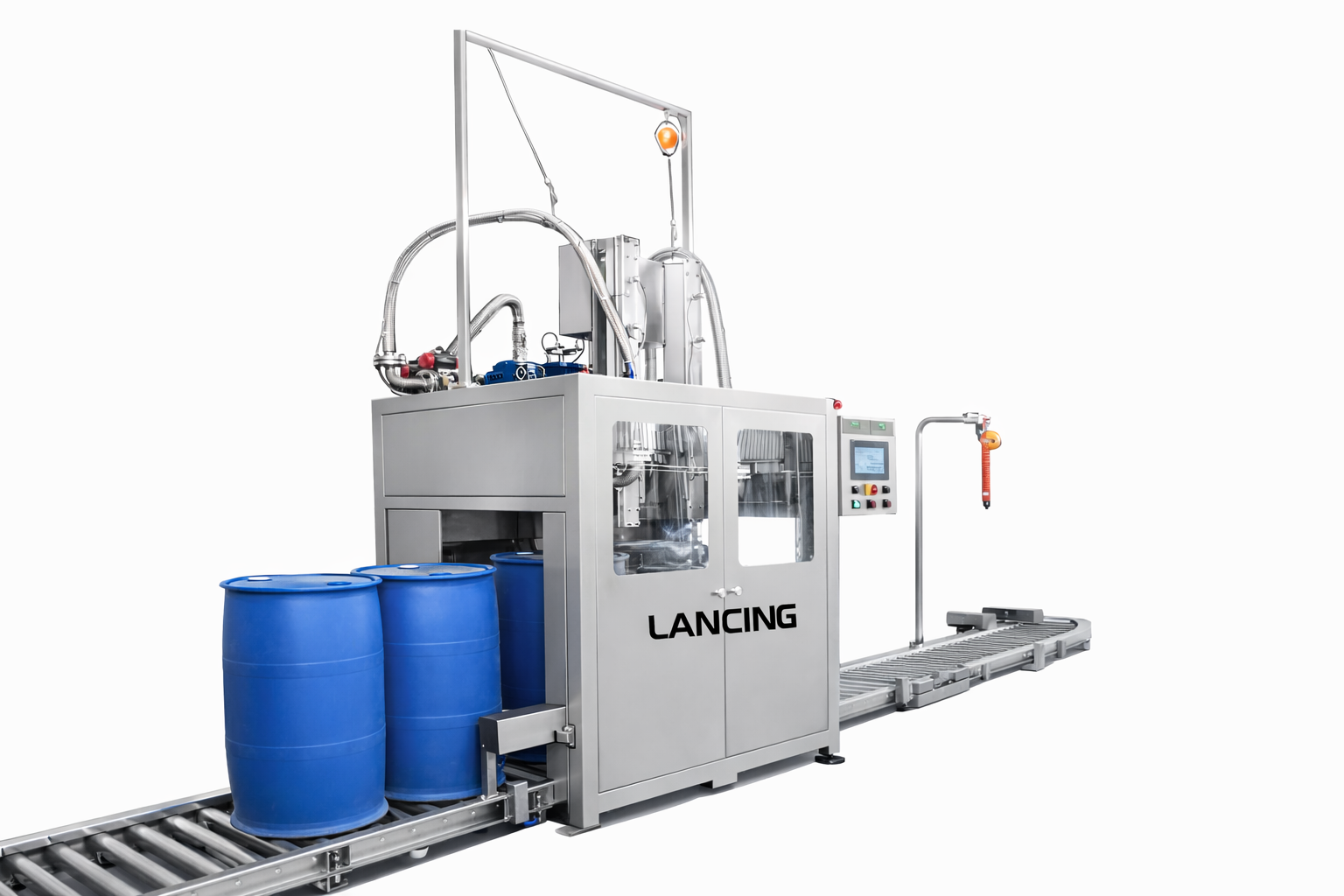
Chemical filling machinery
Protect product-contact parts when filling bleach, acids, cleaners and aggressive liquids, with ATEX features included where your product or site requires them.

Two separate questions
Aggressive chemicals can attack stainless steel, seals, hoses and valves. Flammable products can create a potentially explosive atmosphere. Some projects involve one issue; others involve both.
The exact concentration, temperature, contaminants, cleaning chemicals and dwell time determine the compatible product-contact materials.

Machine comparison

Reference LUYTCR4A gravity platform for conveyor-fed bottles.

Reference LUYTCR6 family with diving nozzles and configurable head count.

A compact route for lower output, trials and flexible chemical production.
Reference automatic platform
| Method | Gravity filling with corrosion-resistant nozzles |
|---|---|
| Filling range | 100–3000 ml |
| Reference speed | Approximately 200–2500 bottles/hour |
| Bottle range | Diameter 60–120 mm; height 60–300 mm |
| Nozzles | 4 standard platform, customisable |
| Electrical supply | 110/220 V, 50–60 Hz reference |
| Power | Approximately 550 W reference |
| Air pressure | 0.4–0.7 MPa reference |
| Hopper | Approximately 90 L |
| Reference size | Approximately 2000 × 1300 × 1900 mm |
| Reference weight | Approximately 200 kg |
Indicative platform data only. Final performance, conformity, utilities and dimensions are confirmed against the product, container, hazardous-area classification and approved project specification.
FAQs
No. Bleach is primarily a corrosive-product and material-compatibility challenge. Whether explosion protection is required depends on the full product composition and workplace assessment.
Depending on compatibility, product-contact routes may use PP, PTFE, PVC or selected alloys and elastomers. Compatibility must be confirmed against the exact chemical concentration, temperature and cleaning method.
Potentially, but that creates a combined specification. Corrosion resistance does not by itself address ignition risks, zone requirements or conformity documentation.
Your machine recommendation
Send your product SDS, container details, fill range, target output and any ATEX information. You’ll receive a practical shortlist matched to your application.
☎ 01494 623015✉ sales@lancinguk.comDirect support for new machines, line upgrades and complete filling projects.
Materials evidence
“Corrosion resistant” is not a single construction standard. Compatibility depends on the exact substance, concentration, contaminants, operating temperature, exposure time, pressure, cleaning medium and mechanical duty. The evidence should cover every wetted component and the foreseeable cleaning state.
| Wetted-path area | Evidence to confirm | Why it matters |
|---|---|---|
| Tank, manifold and valves | Candidate material, concentration and temperature limits, joining method and any coating or lining. | Bulk construction may be suitable while welds, fittings or linings remain vulnerable. |
| Seals and elastomers | Exact seal compound, swelling or embrittlement data, service life and replacement method. | A compatible body material does not protect an unsuitable seal. |
| Hoses and tubing | Inner liner, reinforcement, end fittings, bend radius, permeation and static behaviour. | Flexible connections can introduce chemical, mechanical and electrostatic constraints. |
| Pump and meter | Wetted materials, operating principle, viscosity range, dry-running limits and cleanability. | The dosing device often contains several different materials and clearances. |
| Nozzles and drip control | Body, valve seat, seals, cut-off, retained volume and dismantling or flush method. | Nozzle residues affect drips, cross-contamination and operator exposure. |
| Cleaning state | Flush medium, temperature, contact time, disposal and evidence of a clean or neutral condition. | The cleaning chemical can be less compatible or more flammable than the product. |
The source data and supplier approval should relate to the actual formulation and operating conditions. Unknown cells in a compatibility review should remain open actions rather than being filled with assumptions.
Combined specification
A machine may need only corrosion-resistant contact parts, only hazardous-area protection, or both. The product SDS and formulation support both reviews, but the conclusions are different. The material review addresses degradation, contamination, leakage and cleaning; the ATEX/DSEAR review addresses explosive atmospheres, ignition sources, release control and the site classification.
Where practical, run the real product through representative wetted components and observe fill behaviour, staining, swelling, leakage, valve response and cleaning. Longer-term compatibility may require supplier data or controlled exposure evidence beyond a short filling trial.
Agree inspection points and consumable replacement intervals. Seals, hoses and valve seats should be identifiable in the spare-parts list so that a future substitution does not silently change the approved material route.
Define drainage, drip trays, bund or local containment interfaces, transfer connections and the route for waste or recovered product. Cleaning access should avoid creating an uncontrolled splash, vapour or incompatible mixture.
If the product or cleaning medium can create an explosive atmosphere, the cleaning mode belongs in the hazardous-area and operating assessment. A machine that is safe during production cannot automatically be assumed safe during open flushing or maintenance.
No material should be treated as universally suitable. Confirm the exact grade, product formulation, concentration, temperature, pressure, exposure and mechanical duty using reliable supplier or test evidence.
Suitability depends on the exact chemistry and conditions. Chlorides, oxidisers, concentration and temperature can change corrosion behaviour, so the wetted-path material should be approved for the declared product rather than selected from a broad product category.
Provide the current SDS, full formulation or concentration where available, operating and cleaning temperatures, exposure time, pressure, viscosity, proposed cleaning media and any existing compatibility or service-history evidence.
General chemical-filling selection where no hazardous-area intent exists is owned by chemicalfillers.co.uk. This page remains focused on the point where materials compatibility and ATEX requirements may need to be specified together.
Share your SDS, hazardous-area information, containers, fill volumes, target output and any capping or labelling stages.