Automatic
Automatic ATEX filler
For conveyor-fed bottles and cans with a compatible pump or flow-meter route.
View solution
Industrial liquid packaging
Choose a practical filling and handling route for kerosene, additives, lubricants and related liquids in bottles, jerrycans and larger containers.
Application factors
Fuel and solvent components can determine the hazardous-area category and ignition-control requirements.
Low-viscosity fuels and thicker lubricants may need different pumps, fill profiles and nozzles.
One litre bottles, five litre cans and larger jerrycans create different output and handling requirements.
Positive shut-off, suck-back or diving nozzles can improve cleanliness and reduce product loss.
Conveyors, guides and operator access must suit the finished pack mass.
Torque, induction sealing and tamper evidence can be important for transport and storage.
Machinery shortlist
For conveyor-fed bottles and cans with a compatible pump or flow-meter route.
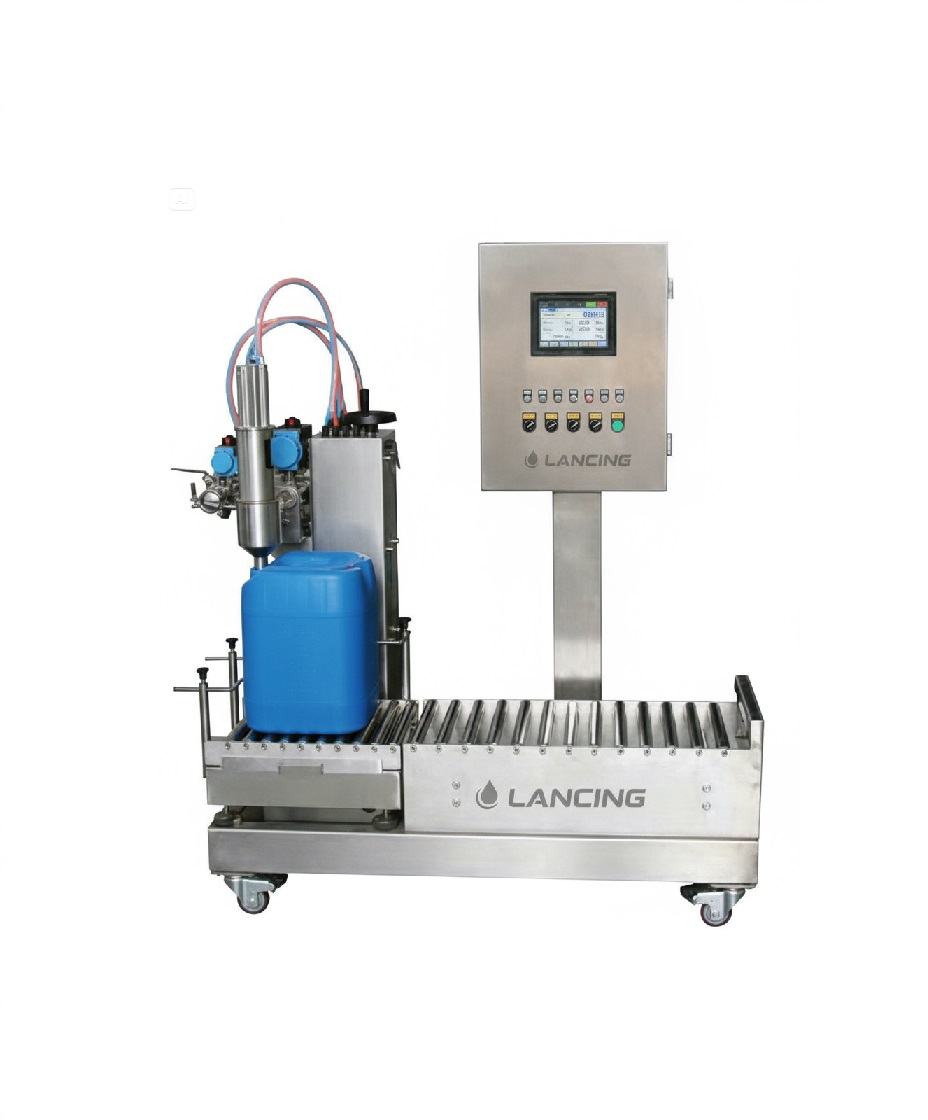
View solutionFor common 10–30 litre containers and mass-controlled filling.
View solutionWeighing, diving nozzles and robust downstream handling for heavier packs.
View solutionQuote checklist
FAQs
Potentially, but the pump, flow path, cleaning, changeover, viscosity range, hazard classification and cross-contamination controls must be reviewed for every product.
It can be a practical route for larger packs. Product density, cut-off, drips, target mass and line speed must be included in the test or specification.
Yes, where compatible with the cap and container. The sealer location and suitability relative to the classified area must be assessed.
Your machine recommendation
Send your product SDS, container details, fill range, target output and any ATEX information. You’ll receive a practical shortlist matched to your application.
☎ 01494 623015✉ sales@lancinguk.comDirect support for new machines, line upgrades and complete filling projects.
Flow, static and large packs
Fuel products, additives and lubricants can span volatile low-viscosity liquids and heavier oils. The intended product range should be separated into operating cases so that the pump, meter, nozzle, cleaning route and hazardous-area controls are not qualified from one unrepresentative sample.
For bottles, piston, pump or compatible flow-meter routes may be compared. For jerrycans and larger packs, weigh filling can provide mass-based control. Density and temperature information are needed when comparing mass and volume targets or converting between them.
Record drips, foaming, splash and residual flow after the stop signal. A shut-off or diving nozzle can improve control for suitable products, but it must fit the container neck and withstand the declared chemical and cleaning conditions.
Product tanks, pumps, hoses, pipework and container materials form one transfer system. The DSEAR assessment should address release sources and electrostatic risk, while the machinery specification identifies bonding points, monitoring, permissives and protected components included in the supply.
Large filled packs also need stable roller or powered transfer, capping access and spill control. The line should avoid moving an open or dripping container into equipment that has not been reviewed against the classified boundary.
| Product-range question | Why it affects the machine |
|---|---|
| Lowest and highest viscosity | Changes pump choice, fill time, pressure, nozzle size and cut-off. |
| Volatility and flash point | Influences release control, area classification inputs, extraction and protection requirements. |
| Conductivity and container material | Affects the static-control assessment and how bonding or earthing provisions are applied. |
| Bottle, jerrycan or drum | Changes the measurement route, handling, nozzle travel and closure stage. |
It may be possible over a defined range, but the pump, motor or air drive, seals, pressure, fill time, cut-off and cleaning need to be checked at both extremes. A trial should not qualify products outside the tested or approved envelope.
Yes. The scale controls mass, but density is needed when the commercial fill is expressed as volume, when product temperature changes, or when comparing weigh and volumetric routes. State the measurement basis and operating temperature.
Typical SAT items include final product connections, earthing and bonding, extraction or ventilation interfaces, utilities, equipment location, line integration, operator procedures and any site-dependent safety functions identified in the project scope.
Further selection
Use the large-pack filling route for jerrycans and drums, the bottle filling page for smaller packs, and the guides to vapour control and maintenance for installed operation.
Fuel and additive quantity control
A recipe intended for one fuel or additive grade should not be treated as proof for another grade with different density, viscosity or compatibility. Record the actual formulation and operating temperature when comparing volumetric and mass-based results. A temperature-driven density change may alter the volume represented by a given mass; it is not automatically a defective filler.
They can form part of an agreed method where suitable density information and the required conditions are established. The conversion must use the actual product, not a generic oil or water value. Confirm the applicable quantity-control requirements and the suitability of the measuring equipment for the intended sale and environment.
Use quantity verification and checkweighing with flowmeter versus load-cell selection. Keep product and flush identification in the changeover record to avoid turning a measurement investigation into a contamination problem.
Provide product-grade data, the declared quantity basis, container details and the acceptance method with the machinery enquiry.
Share your SDS, hazardous-area information, containers, fill volumes, target output and any capping or labelling stages.