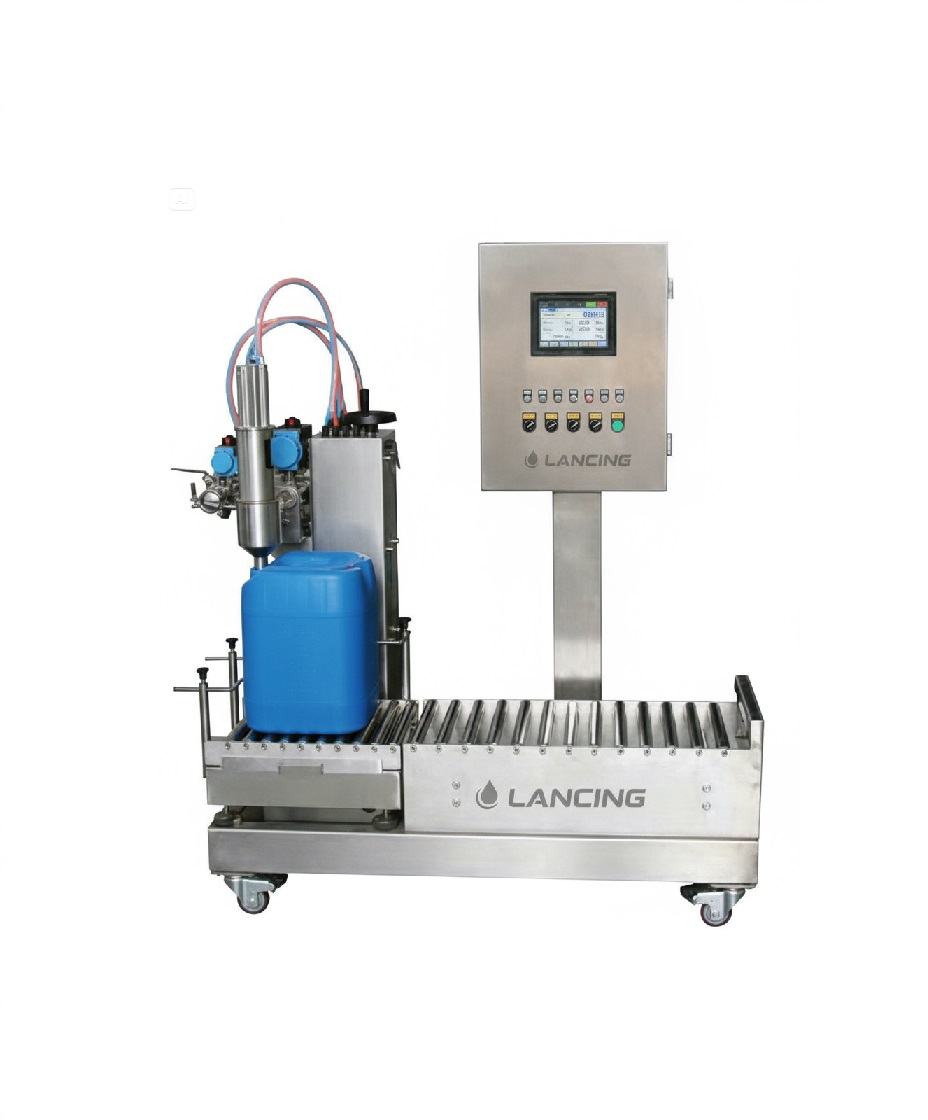
Jerrycan, pail and drum filling
ATEX Bucket & Drum Filling Machine
Fill heavier containers with better control of weight, splash, foam, operator access and safe movement of the finished pack.

Machine overview
A practical solution for heavier finished packs.
Five to thirty litre containers create different handling and ergonomic questions from small bottles. Weighing, diving nozzles, feed pumps and roller or powered conveyors can be combined to control filling and move the heavier finished container safely to capping or discharge.
Where the product or environment is hazardous, the filler and every related component are reviewed against the declared classification. Large-pack projects also need early decisions about manual handling, cap application, pallet preparation and cleaning access.
Hazardous-area suitability is project-specific.
The final machine category, marking, electrical and non-electrical equipment, controls, documentation and installation requirements must match the competent site assessment and agreed specification.

Key features
Tailored to your product and production needs.
Weigh-by-fill control
An integrated scale can stop the fill at the target mass and support repeatable large-volume dosing.
Diving nozzles
Nozzles can follow the rising liquid level to reduce splash and foam for suitable products.
Product feed pump
A compatible pump maintains supply to the filling head and is selected around viscosity and hazard.
5–30 litre range
A practical reference platform for pails, jerrycans, cans and small drums.
Container transfer
Roller or powered conveyors are planned around filled weight, stability and operator workflow.
Capping integration
Manual, assisted or automatic closure handling can be considered in the same layout.
Technical data
Key capabilities to confirm for your project.
| Platform reference | LUGTW2S family / configured hazardous-area variant |
|---|---|
| Reference fill range | 5–30 L |
| Reference output | Approximately 100–120 containers/hour, volume and product dependent |
| Reference accuracy | ±0.5% on suitable weigh-fill applications |
| Nozzles | One or two diving heads, project dependent |
| Product supply | Compatible gear pump or alternative feed system |
| Maximum weighing | Up to 50 kg on reference platform |
| Air supply | Approximately 0.5–0.7 MPa reference |
| Electrical supply | Project-specific; reference non-ATEX platform data may use 380 V, 50 Hz |
| Conveying | Roller or powered conveyor, length and height to layout |
| Options | Cap application, fume interface, drip tray, grounding, pallet handling and integrated line controls |
Indicative platform data only. Final performance, conformity, utilities and dimensions are confirmed against the product, container, hazardous-area classification and approved project specification.
Applications
Typical applications.
Industrial solvents
Larger packs of compatible flammable solvents and cleaners.
Paints and coatings
Pails and cans where viscosity, splash and lid handling affect the line.
Oils and additives
Lubricants, kerosene and compatible products requiring robust large-pack handling.
Typical supply scope
Support from specification to start-up.
- Configured weigh filling station
- Scale, nozzle and product-feed arrangement
- Roller or powered conveyor sections as specified
- Protected controls and static provisions to agreed scope
- Documentation, training and optional commissioning
Quote brief
Send these details for a faster, more accurate recommendation.
- Jerrycan, bucket or drum drawings and filled weight
- Product SDS, density, viscosity, foam and compatibility
- Hazardous-area classification and extraction details
- Target output and operator involvement
- Closure type, torque or lid-press requirement
- Downstream conveying, labelling and pallet workflow
Questions
Questions about bucket and drum filling.
Can the same machine fill 5 litre and 30 litre containers?
A wide range may be possible, but nozzle travel, scale capacity, container geometry, change parts, fill time and operator workflow must be reviewed.
Can capping be included?
Yes. Screw capping, lid pressing or operator-assisted closure stages can be integrated, subject to the closure, container and hazardous-area requirements.
How are foamy products handled?
Diving or bottom-up nozzles, controlled fill profiles and suitable cut-off can help, but the product should be assessed or trialled at the required dose and speed.
Your machine recommendation
Tell us what you need to fill — we’ll recommend the most suitable machine.
Send your product SDS, container details, fill range, target output and any ATEX information. You’ll receive a practical shortlist matched to your application.
☎ 01494 623015✉ sales@lancinguk.comDirect support for new machines, line upgrades and complete filling projects.
Large-pack engineering
Treat container handling, nozzle travel and product supply as part of the fill.
The LUGTW2S reference family covers a configured 5–30 litre route, but the practical machine is defined by the pack geometry, filled weight, neck position, product flow and the operator or conveyor sequence. A stable fill is only useful when the finished container can be closed and moved without creating a spill or manual-handling problem.
Container presentation and ergonomics
Record the base, handle, neck offset and centre of gravity of every bucket, pail or jerrycan. The scale, guides and nozzle need to locate the pack repeatably. For manual loading, agree the lift, reach and finished-pack movement; for conveyor loading, agree the roller pitch, drive, stops and how the scale is isolated during measurement.
The proposed closure stage should be included from the beginning. A screw cap, plug, lid or bung can change the container support, operator access and the point at which vapour or product remains exposed.
Product feed and nozzle control
Large doses place greater demand on the feed pump, hose and valve. Specify viscosity and density at operating temperature, supply pressure, source vessel, batch level variation and whether recirculation is required. The fill profile may use coarse and fine stages to balance output and cut-off.
Diving nozzles can reduce splash or foam for suitable products, but the travel, nozzle diameter, material, bottom clearance and withdrawal speed require confirmation with the real pack. A drip tray or local containment should be sized around the credible release and cleaning method, not used as a substitute for process control.
Plastic packs do not become safely earthed by attaching an arbitrary clamp.
Static-control measures depend on the product, conductivity, container material, fill method and wider transfer system. The competent risk assessment should define the control strategy, while the machine specification identifies the monitoring, interlocks and connection points included in the supply.
Trial and FAT
Test the pack-handling sequence as well as fill accuracy.
| Test stage | What to observe |
|---|---|
| Empty-pack loading | Stable positioning, tare method, handle clearance and correct detection of missing or misaligned packs. |
| Nozzle entry | Neck clearance, bottom position, splash, foam and contact avoidance across the complete container range. |
| Cut-off | Coarse/fine response, residual flow, drips and result against the agreed measurement method. |
| Closure and transfer | Safe access, cap or lid handling, container stability and movement of the finished weight. |
| Cleaning and recovery | Drainability, retained product, flush route, drip-tray access and waste or product-recovery arrangements. |
Does the published 5–30 litre range cover every bucket or jerrycan?
No. It is a reference fill range. The container height, base, neck position, stability, handle, nozzle travel, scale capacity and finished-pack handling must all fit the configured station.
Can large plastic containers be filled with an earthing clamp?
An earthing clamp is not automatically effective on an insulating plastic container. Static control needs to consider the product, container, operator, product supply and surrounding equipment. The solution may involve several measures defined by the competent assessment rather than a single accessory.
What FAT evidence is most useful for a bucket or drum filler?
Use real containers and closures, the agreed product or representative medium, a stated run length, mass or volume measurement records, output timing, nozzle and drip observations, alarm/interlock checks, operator-handling observations and a list of site checks reserved for SAT.