Large-volume mass filling
ATEX Weigh Filling Machine
Fill common 10–30 litre containers accurately by weight with a compact system matched to your liquid, pack handling and hazardous-area requirements.
Machine overview
Control larger fills by mass.
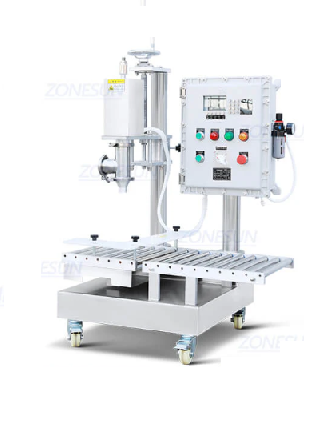
Weigh filling is often compared for larger containers where the target is best controlled by mass. The platform combines a weighing base, product discharge arrangement and protected controls, with nozzle and static-control options selected for the application.
Container material, earthing method, product volatility, splash control and the way filled containers leave the station all need to be included in the project brief.
Hazardous-area suitability is project-specific.
The final machine category, marking, electrical and non-electrical equipment, controls, documentation and installation requirements must match the competent site assessment and agreed specification.
Key features
Tailored to your product and production needs.
Protected control enclosure
Control equipment is specified for the declared hazardous-area requirements and project scope.
10–30 litre route
A practical reference range for gallons, jerrycans and smaller drums.
Mass-based control
The weighing platform controls the fill against the target mass rather than a fixed piston volume.
Splash-managed discharge
Nozzle and outlet formats can be selected around product behaviour and container neck.
Compact footprint
A standalone station can suit lower-output or operator-assisted large-pack production.
Static-control options
Earthing, bonding and anti-static components can be incorporated where required.
Technical data
Key capabilities to confirm for your project.
| Platform reference | LUYTEXW1 |
|---|---|
| Fill range | 10–30 L |
| Reference capacity | Approximately 3–6 containers per minute, volume and product dependent |
| Reference accuracy | ±1% |
| Maximum weighing range | Up to 30 kg |
| Discharge | Splash-managed / spray-proof outlet configuration |
| Electrical supply | 110/220 V, 50–60 Hz, approximately 100 W reference |
| Air supply | 0.5 MPa ± 0.1 MPa reference |
| Air consumption | Approximately 5 m³/h reference |
| Reference size | Approximately 800 × 650 × 1450 mm |
| Reference weight | Approximately 100 kg |
| Options | Alternative nozzles, grounding, anti-static kit, conveyors and extraction interface |
Indicative platform data only. Final performance, conformity, utilities and dimensions are confirmed against the product, container, hazardous-area classification and approved project specification.
Applications
Typical applications.
Solvents
Acetone, ethanol, isopropanol and thinners after full compatibility and hazardous-area review.
Fuels and additives
Kerosene and compatible fuel or additive products, subject to competent assessment.
Industrial chemicals
Flammable cleaners, reagents and speciality liquids in larger containers.
Typical supply scope
Support from specification to start-up.
- Weigh-fill base machine and scale
- Configured discharge / nozzle assembly
- Protected control enclosure to agreed scope
- User documentation
- Optional conveyors, grounding and commissioning
Quote brief
Send these details for a faster, more accurate recommendation.
- Product SDS and target fill mass / volume
- Container material, dimensions, opening and handle position
- Zone and hazardous-area assessment details
- Required containers per hour
- Earthing / bonding approach and extraction
- Operator loading, cap application and finished-pack handling
Questions
Questions about ATEX weigh filling.
Why use weigh filling for 10–30 litre containers?
Mass-based filling can be a practical route for larger packs, particularly where product density and the required declared quantity are managed through a weighing system.
Can the station be conveyorised?
Yes. Roller or powered conveyor sections can be planned around container weight, operator access, capping and downstream transfer.
Is ±1% accuracy guaranteed for every product?
No. It is a reference platform value. The practical tolerance must be confirmed against the product, target amount, flow behaviour, cut-off, scale setup and operating conditions.
Your machine recommendation
Tell us what you need to fill — we’ll recommend the most suitable machine.
Send your product SDS, container details, fill range, target output and any ATEX information. You’ll receive a practical shortlist matched to your application.
☎ 01494 623015✉ sales@lancinguk.comDirect support for new machines, line upgrades and complete filling projects.
Load-cell filling
Control the complete weighing cycle, not only the final number on the display.
The LUYTEXW1 reference platform uses mass-based control for common 10–30 litre packs. Practical performance depends on tare handling, product flow, coarse and fine cut-off, drips after valve closure, container movement and the stability of the weighing installation.
Tare, target and cut-off
Decide whether each empty container is individually tared, whether a stored tare is acceptable and how container-weight variation affects the declared quantity. The controller needs a stable reading before filling and a repeatable cut-off strategy as the target is approached.
Product viscosity, head pressure, pump response and nozzle closure affect the material still moving after the stop command. A two-stage or controlled fill profile may be needed to balance cycle time and overshoot. The quoted tolerance should state the product, target mass, test method and operating conditions.
Installation and hazardous-area interfaces
The scale needs a stable base and protection from external forces such as rigid pipework, operators leaning on the platform or a powered conveyor pushing the container during measurement. Hose routing and nozzle support should avoid transferring variable load into the weigh frame.
Container conductivity, product transfer, earthing and bonding require project-specific review. A conductive metal pack can be treated differently from a plastic jerrycan, but neither should be handled through a generic assumption. The competent DSEAR and area-classification inputs remain essential.
| Acceptance item | Evidence to agree |
|---|---|
| Zero and tare | Stable zero, tare method, container-weight variation and response to an absent or incorrectly positioned pack. |
| Fill result | Target mass, permitted tolerance, measurement instrument, sample size, product temperature and fill profile. |
| Throughput | Sustained containers per minute for the declared product and quantity, including placement and removal. |
| Drip and splash | Nozzle closure, residual drip, splash containment and the condition of the container before capping or transfer. |
| Alarms and interlocks | No-container, unstable-weight, overfill, extraction or earthing interfaces where included, emergency stop and safe restart. |
Operation and lifecycle
Design for heavy packs, verification and cleaning access.
Pack movement
Roller or powered transfer must suit the filled weight, base geometry and operator workflow without disturbing the scale during the measurement cycle.
Verification
Define routine checks, reference weights, calibration responsibilities and the action taken when results drift outside the agreed process limit.
Wash-down and spills
Confirm the cleaning method, drip tray, drainage, product recovery and whether the load cell and surrounding equipment require additional protection.
Should the filler use gross or net weight?
The control strategy should be defined from the production and declared-quantity requirement. Net filling normally needs a reliable tare for the empty pack, while a gross target includes the container. The quotation and FAT method should state which value is controlled and how it is verified.
Can a plastic jerrycan be earthed in the same way as a metal container?
No generic rule should be applied. Conductive metal containers, dissipative materials and insulating plastics behave differently. The product, container, transfer arrangement and static-control measures need a competent assessment, with any earthing or bonding device specified for the real operating case.
How should the weigh station be cleaned between products?
Define which wetted parts are drained, flushed or dismantled, how residual product is captured, which cleaning medium is used and how the clean state is verified. The procedure must also account for any flammability or compatibility risk introduced by the cleaning medium.