Fully pneumatic station
Can reduce electrical equipment at the fill point, but still needs complete mechanical, static, materials, process and utility assessment. Operator actions and closure transfer remain part of the operating case.

Pneumatic filling question
Removing an electric motor does not remove every ignition source or make the complete filling process suitable for a hazardous area.
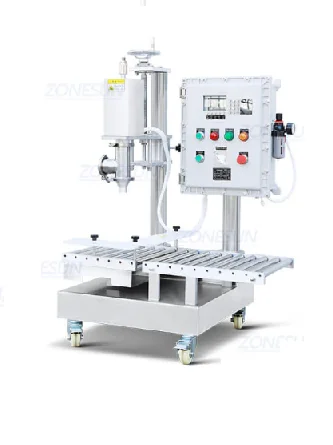
No. A pneumatic filling machine is not automatically ATEX safe or suitable for a hazardous Zone simply because it uses compressed air instead of an electric drive. The complete assembly and process still need review for mechanical ignition sources, static electricity, hot surfaces, product releases, valves, sensors, foot controls, earthing, materials, extraction, product supply and connected equipment.
Great Britain’s explosive-atmospheres equipment regulations apply to electrical and mechanical equipment intended for explosive atmospheres. Final suitability depends on the competent site classification and the documented equipment duty.
Risk review
| Area | Why it still matters | Evidence to request |
|---|---|---|
| Mechanical ignition | Friction, bearings, impact, seized parts and moving mechanisms can create heat or sparks. | Non-electrical ignition-source assessment, maintenance limits and fault response. |
| Electrostatic charge | Liquid flow, hoses, plastic containers and operator actions can generate or retain charge. | Earthing and bonding strategy, material properties and representative tests. |
| Pneumatic components | Valves, actuators, tubing, exhausts and foot controls must suit the environment and failure mode. | Equipment schedule, intended location, component evidence and safe-state design. |
| Electrical accessories | Many “pneumatic” machines still use sensors, scales, solenoids, HMIs or remote controls. | Complete electrical architecture and location of each item relative to the Zone. |
| Product and vapour release | The fill point, drain-down, cleaning and container transfer can create an explosive atmosphere. | SDS, release scenario, extraction, containment and operating procedure. |
| Compressed-air supply | Air quality, pressure loss and failure can change valve positions and machine behaviour. | Utility specification, fail-safe valve state and loss-of-air acceptance test. |
Architecture comparison
Can reduce electrical equipment at the fill point, but still needs complete mechanical, static, materials, process and utility assessment. Operator actions and closure transfer remain part of the operating case.
Uses compressed air for movement with electrical sensors, valves or controls. The equipment schedule must show which items are in the Zone and which safety functions depend on external panels or barriers.
Can be appropriate when motors, drives, controls and the assembled machine are selected and assessed for the intended duty. Electrical drive is not automatically unsuitable, just as pneumatic drive is not automatically suitable.
Use HSE’s ATEX equipment guidance, hazardous-area classification guidance and the Great Britain equipment-regulations guidance with the competent project assessment.
Buyer questions
Only when the control and its complete interface are suitable for the intended location and operating duty. A mechanical or pneumatic pedal still needs consideration of materials, static, impact, hoses, failure modes and operator use.
No. Static can arise from product flow, hoses, containers, transfer and people regardless of the drive method. The competent assessment must define what can be earthed or bonded and how continuity is verified.
Do not assume so. The complete machine, materials, ignition sources, components, operating limits and intended location must be assessed against the approved Zone, gas group and temperature requirement.
Neither architecture is universally better. Choose between operator-assisted and automatic equipment using the product, container, output, repetitive handling, closure route, control functions, hazardous-area duty and acceptance evidence.
The project must define the fail-safe state of every valve, actuator, nozzle and product-supply interface. Loss of air should be tested so that product does not continue to flow or leave the machine in an uncontrolled restart condition.
Send the SDS, area classification, fill range, containers, product-feed pressure, air supply, operator sequence, control components, extraction, cleaning method and target output. Lancing can then compare a semi-automatic, weigh or automatic route.
Related machinery choices
Review operator-assisted filling, permissives, handling and changeover.
Compare conveyor-fed machinery, controls and line integration.
Define conductive paths, containers, monitoring and continuity evidence.
Your machine recommendation
Send your product SDS, container details, fill range, target output and any ATEX information. You’ll receive a practical shortlist matched to your application.
☎ 01494 623015✉ sales@lancinguk.comDirect support for new machines, line upgrades and complete filling projects.
Share your SDS, hazardous-area information, containers, fill volumes, target output and any capping or labelling stages.