
Small and medium packs
ATEX Bottle Filling Machines
Plan bottle filling for flammable or volatile liquids around the product, neck opening, container material, closure, output and competent hazardous-area requirements.
Container-led selection
Start with the bottle journey, not only the nominal fill volume.
An ATEX bottle filling project needs a stable, repeatable route from empty-container presentation to closure application and discharge. Bottle material, dimensions, neck opening, stiffness and manufacturing variation influence locating, nozzle access and transfer. Product behaviour and the classified environment then determine the dosing, cut-off, static-control and extraction interfaces.
Bottle control
Define infeed orientation, spacing, guides, indexing, neck access and how unstable or lightweight packs are supported.
Fill profile
Compare nozzle diameter, entry depth, bottom-up movement, flow stages and cut-off against foam, splash, vapour and stringing.
Closure route
Plan cap presentation, placement, torque or crimping, open-bottle travel and rejected-pack handling within the complete process.
Automation choice
Compare operator-assisted and conveyor-fed bottle filling against the real production pattern.
| Route | Where it can fit | Questions to close |
|---|---|---|
| Semi-automatic bottle filling | Short runs, frequent changes, development work or lower output where an operator can present and remove each bottle safely. | Operator task, repetitive handling, earthing approach, open-pack exposure, closure method and cycle evidence. |
| Automatic bottle filling | Conveyor-fed production where indexing, multi-head dosing and downstream equipment can be balanced as a line. | Sustained output, bottle control, fill-time distribution, accumulation, rejects, capping and line permissives. |
| Complete fill-cap-label line | Projects that need empty-container handling, filling, closure application, coding, inspection, labelling and discharge coordinated together. | Hazardous-area boundary, interfaces, cause-and-effect logic, documentation and FAT/SAT scope. |
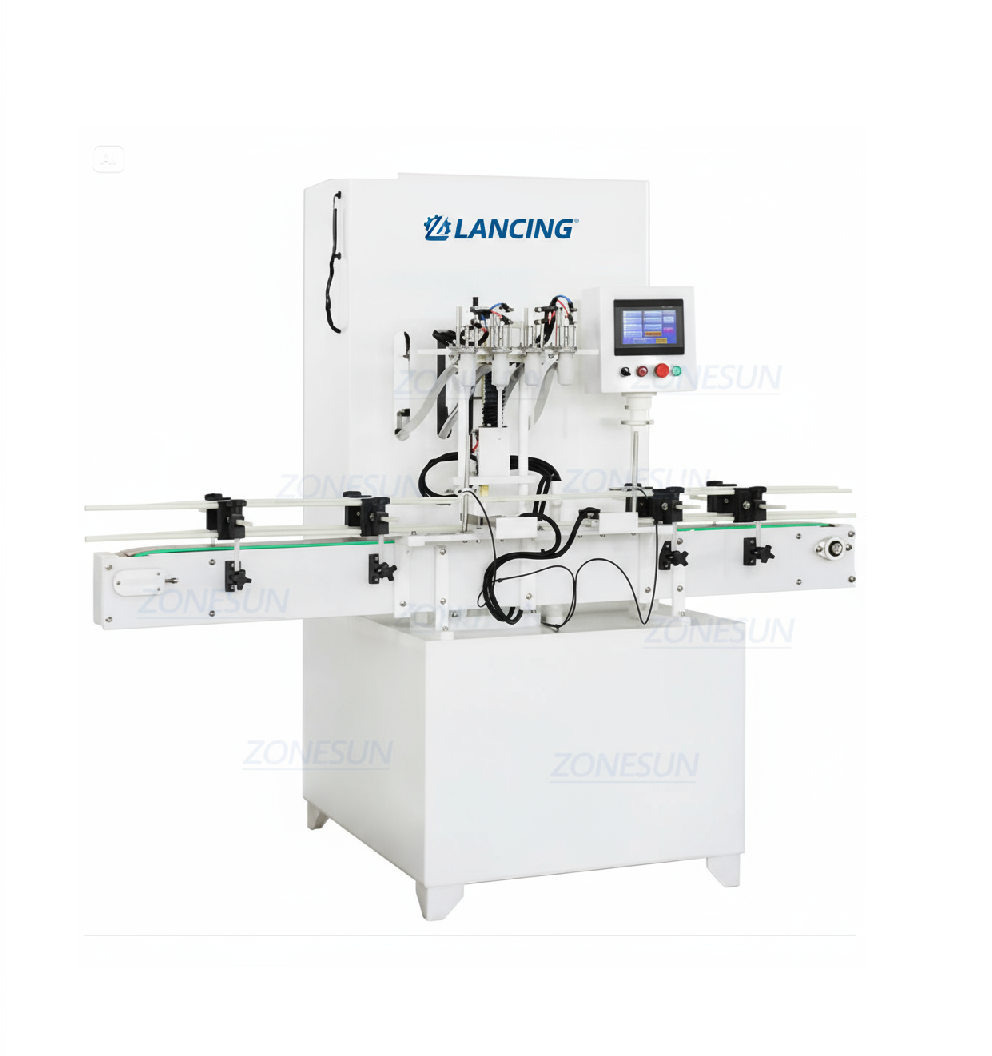
The automatic platform already described on this site publishes a reference route of 50–5000 ml with 1–6 filling heads, configuration dependent. Those figures are not a promise for every product or bottle; the final range and output are confirmed through the product, pack and project specification.
Product behaviour
Control the fill without assuming every low-viscosity liquid behaves the same.
Record product temperature, density, viscosity, conductivity, vapour behaviour, foam, wetting and any solids. A low-viscosity solvent may flow rapidly but can expose limitations in cut-off, dripping, vapour capture or static-control strategy. Alcohol-rich or fragrance products may also impose material, seal and cleaning requirements that are not visible from the fill quantity alone.
The nozzle profile may use staged flow or controlled travel where technically suitable. Representative trials should observe bottle wetting, splash, foam, fill consistency, cut-off and the effect of repeated production—not just one successful fill.
Pack and closure
Keep the bottle stable from infeed to a secure closure.
Lightweight plastic bottles, narrow bases, tall formats and variable glass can require different rails, guides or indexing. The open bottle should not be allowed to travel through an unreviewed area simply because filling has finished. Capping location, cap feeder, torque or crimp method, reject handling and any closure inspection belong in the line plan.
See the alcohol and perfume application page and the chemical and solvent application page for product-specific questions.
Bottle-filling trial
Test the complete format range and define the acceptance method before FAT.
- Supply representative bottles from the normal manufacturing tolerance, not only perfect samples.
- Include every closure, liner, pump or crimp component that affects open-container time or handling.
- Provide the real product where safe and practical, or agree a justified representative medium and its limitations.
- State the operating temperature, fill range, measurement method and target sustained output.
- Observe nozzle entry, splash, foam, cut-off, bottle stability, cap handling, rejects and cleaning.
- Record which site-dependent extraction, earthing, installation and SAT checks remain open.
Buyer questions
Questions about ATEX bottle filling.
What bottle information is needed before selecting an ATEX filler?
Provide drawings or samples for every bottle and closure, including dimensions, neck opening, material, empty weight, stability and any surface or label restrictions. Include the fill range and the intended presentation method.
Can the same machine fill glass and plastic bottles?
Potentially, but handling, static behaviour, dimensional variation, impact risk and closure application differ. Both pack families should be reviewed and included in representative trials.
Is bottom-up filling always required for flammable liquids?
No single nozzle movement is correct for every product. Diving or bottom-up filling may help with splash, foam or vapour release for suitable packs, but the final profile must be based on the product, neck geometry and process assessment.
Can capping and labelling be included?
Yes. Closure handling, capping, coding, inspection, labelling and conveying can be planned as a coordinated line. The hazardous-area boundary and suitability of each stage must be addressed in the project scope.
What limits bottle-filling output?
The real dose, product flow, number of heads, nozzle profile, indexing, bottle stability, closure handling, rejects and downstream capacity all contribute. Use a sustained filled-pack acceptance test rather than a dry-cycle figure.
Your machine recommendation
Tell us what you need to fill — we’ll recommend the most suitable machine.
Send your product SDS, container details, fill range, target output and any ATEX information. You’ll receive a practical shortlist matched to your application.
☎ 01494 623015✉ sales@lancinguk.comDirect support for new machines, line upgrades and complete filling projects.