
Ink packaging
Solvent-Based Ink Filling Machines
Plan finished-ink filling around colour control, pigment behaviour, containers, hazardous-area conditions and the quality check after closing.
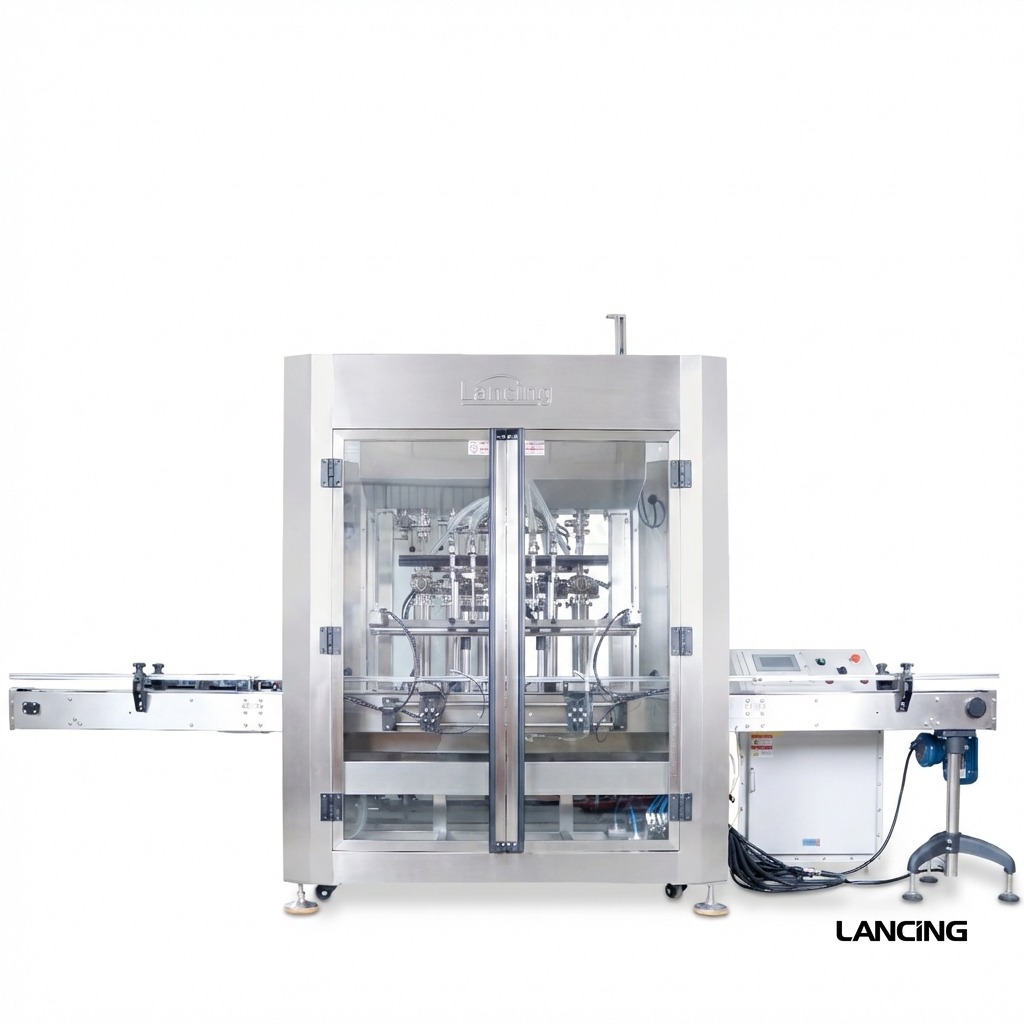
Finished ink packaging
Specify a solvent-based ink filler around the finished batch, not only its viscosity.
A solvent-based ink filling machine transfers a finished ink into sale or production containers; it is not the same machine as a colour-formulation dispenser. Selection needs the ink formulation, pigment behaviour, container opening, declared fill quantity, cleaning method and hazardous-area brief. A printable ink can still present settling, foaming, abrasion, vapour and residual-colour problems at the filler.
This application guide covers filling finished flexographic and gravure inks, solvent-carried printing inks and compatible varnishes for review. It does not claim that every Lancing platform is suitable for every ink or that a particular model has already been tested with your formulation. Water-based and UV-curing inks need their own compatibility and exposure assessment; an ink family name does not determine ATEX requirements.
Process decisions
Distinguish the ink properties that change the filling specification.
| Variable | Why it changes the machine decision | Useful evidence |
|---|---|---|
| Pigment settling | Uniform dose mass does not prove that pigment concentration remained uniform. The feed condition must be controlled. | Batch hold time, mixing instructions and samples from the start and end of a normal run. |
| Viscosity and shear | A viscosity value without temperature and test conditions can misrepresent flow through pumps and valves. | Product technical data, working temperature, test method and any limits on shear or recirculation. |
| Solids and wear | Pigments, agglomerates and additives may affect clearances, valve seating and service intervals. | Solids content, particle information and the product supplier’s filtration restrictions. |
| Solvent and cleaning liquid | The ink and the wash fluid can present different compatibility, vapour and static-control duties. | Current SDS for each product and cleaner, plus the complete wetted-parts review. |
| Pack and closure | Pail rims, bottle necks and closure seats can be contaminated by a small amount of tailing ink. | Drawings and samples of the container, lid, liner and label format. |
Feed and fill
Keep batch conditioning separate from the dosing decision.
The production team should define how the batch is kept representative before the filler receives it. A feed tank, recirculation loop or agitator may be part of that scope, but none should be assumed from the presence of a filling head. Review whether agitation introduces air, whether a long stop changes the ink condition and what restart checks are required. Do not add a filter simply to protect the filler if it could remove intended pigment or change the ink specification.
Compare mass-based filling for suitable pails with conveyor-fed automatic filling for bottles and smaller containers. Measurement method alone does not resolve colour uniformity, solvent loss or nozzle cut-off. The product-feed pump guide helps define the pressure, pulsation and cleaning interfaces without assuming a pump type is suitable for the formulation.
Colour change and waste
Evaluate a colour change as a production task, not just a flushing time.
Agree how residual ink is drained, which return stream is allowed, which hoses or nozzles are dedicated and who releases the next colour. Record the accepted cleaning endpoint using the ink producer’s quality method. A visually clean rinse can be a useful observation, but it is not evidence that all incompatible ingredients or colour carryover have been removed.
Contain open waste and wash operations within the site’s assessed method. HSE identifies fire and explosion risks from flammable inks in flexographic and gravure printing, and separately addresses health exposure to inks and cleaning solvents. Equipment selection must therefore consider both ignition control and exposure control; an ATEX marking is not an occupational-exposure assessment.
Primary sources: HSE fire and explosion risks in printing and HSE COSHH guidance for printers.
Acceptance evidence
Trial the awkward batch transitions as well as steady filling.
- Identify the finished ink, batch revision and agreed conditioning method. Retain representative container and closure samples.
- Agree how net quantity is verified, when the container is closed and how external drips are excluded from the result.
- Include a normal pause and restart under the approved procedure; record first-pack behaviour and nozzle cleanliness.
- Include a difficult colour transition and record retained product, wash usage and quality-release checks rather than assuming zero carryover.
- Check the accepted-pack output through closure and handling, not only the filler’s fastest cycle.
Use the fill-accuracy verification guide and trial and FAT guide to turn those observations into agreed acceptance evidence. No trial outcome, cleaning time or output figure is promised here.
Ink-filling questions
Questions about packaging solvent-based printing inks.
Is an ink filler the same as an ink dispensing system?
No. An ink filler packages a finished product to a target quantity; an ink dispensing system may combine several ingredients to create a batch or colour. An enquiry should state whether the formula already exists at the filler inlet or whether ingredient metering and mixing are also required. This page addresses finished-product packing.
Can one filling machine run several ink colours?
A shared machine is a route to assess, not a guarantee of clean changeover. Colour carryover, incompatible ingredients, trapped volumes, hose identity and the agreed clean-state test determine whether sharing is acceptable. Dedicated product-contact parts or separate stations may be preferable where the transition cannot be verified reliably.
Should ink be filtered before filling?
Only use filtration that the ink producer has approved for the finished product. A finer filter may restrict flow or remove material needed for the ink’s performance. Provide the existing filter specification, solids information and acceptable pressure conditions so the filler can be reviewed as part of the approved product route.
What samples help specify an ink filling machine?
Provide the current SDS and technical data, representative finished ink agreed for safe testing, container and closure samples, target quantities, batch sizes, colour-change sequence and cleaning method. Identify any solvent, pigment or recipe variant that is likely to behave differently instead of presenting one easy sample as representative of the whole range.
Application review
Bring the ink, pack and quality method into the same enquiry.
Send the finished-ink details, hazardous-area information and container range. Lancing can review the filling route and identify the evidence needed before a machine configuration is agreed.